


Connected TV Advertising: What Independent Media Producers Need to Know
Producing Commercials for Streaming TV: Platforms, Costs, and Opportunities
Television advertising is becoming a practical conversation for smaller businesses. Self-service platforms let advertisers select audiences, upload commercials, set budgets, and review results without arranging a traditional television buy.
For an independent media producer, that creates two possible roles: making the commercial and helping manage the campaign. Those roles require different skills, and understanding the distinction helps you decide what to offer.
Before buying equipment or promising clients results, understand where the ads run, what the budget purchases, and what the reporting actually measures.
What Is Connected TV Advertising?
Connected TV (CTV) refers to television viewing through an internet-connected television or an attached streaming device. A smart TV, Roku player, or similar device provides access to streaming apps. CTV advertising places commercials within eligible viewing environments. [1]
Over-the-top (OTT) describes internet delivery of video. OTT viewing can happen on televisions, computers, tablets, and phones. Consequently, a streaming advertising package is not necessarily television-screen-only. [7]
Free ad-supported streaming television (FAST) generally means scheduled streaming channels that viewers watch free, with advertising supporting the service. Linear television describes scheduled viewing; traditional broadcast, cable, and satellite are familiar examples, while FAST applies a similar schedule online. [1]
Buying commercial placements does not distribute your complete show or establish your own streaming channel. Those require separate publishing and distribution arrangements. For more on developing and publishing your own programs, see Independent Broadcasting: Creating Your Own Place on Screen.
How MNTN’s Performance TV Works
MNTN markets its advertising platform as Performance TV. Advertisers choose audiences, supply video, set objectives and budgets, and let automated buying technology adjust delivery toward those objectives. MNTN says it has direct inventory relationships with more than 150 streaming networks. [2]
Audience targeting, automated buying, and conversion attribution are industry practices. MNTN Matched and Verified Visits are MNTN product names. “Performance TV” is also used by other vendors to describe an outcome-focused approach; the phrase alone does not establish exclusive technology. [2, 5]
Verified Visits connects qualifying ad exposure with later website activity from a device identified within the same household. This helps measure responses without requiring viewers to click the television screen. It remains a measurement model with defined rules, rather than a direct observation of someone’s reason for purchasing. [10]
Comparing the Companies and Their Offers
U.S. commercial terms checked October 17, 2026. Inventory examples are illustrative. Geography, account eligibility, buying route, and campaign configuration affect availability.
| Platform and company | Inventory examples | Buying options and entry spending | Pricing and fees | Notable tools |
|---|---|---|---|---|
| MNTN / MNTN Inc. [2, 3] | Multiple streaming networks | Self-service with support; homepage advertises no-minimum inventory access; confirm account terms | Dynamic CPM; service share included; no separate technology retainer advertised | Matched audiences, Verified Visits, QuickFrame AI |
| Vibe / Walmart [4] | Advertises 500+ streaming apps/channels | Self-service; marketing says $500 start and $50/day; help page says no campaign minimum | CPM; help page quotes typical $15–$30; no separate platform/subscription fees | Customer audiences, AI creative, conversion reporting |
| tvScientific / Pinterest [5] | NBCUniversal, Hulu, Pluto, Tubi examples | Self-service and managed; demo page advertises no self-service minimum | CPM buying; universal rates and complete fee schedule not publicly verified | Pinterest intent audiences, attribution, incrementality testing |
| Roku Ads Manager / Roku [6] | Multiple streaming apps | Self-service from $500; other Roku buying routes are separate | Dynamic CPM; complete account-specific fees need confirmation | Pixel/API measurement, Action Ads, creative adaptation |
| Amazon Streaming TV / Amazon [7] | Prime Video, Twitch, Fire TV, third-party publishers | Small-business route: no minimum; self-service packages: $10,000 recommended; managed: $50,000 minimum | CPM-based buying; package-specific charges require confirmation | Shopping/streaming audiences, interactive formats, creative services |
| Disney Campaign Manager / Disney [8] | Hulu and Disney+ | Self-service; $500 per campaign | Impression-based buying; no subscription, setup, or installation fees advertised; no universal CPM verified | Geography, demographic and genre targeting; campaign dashboard |
| StackAdapt / StackAdapt Inc. [9] | Multiple CTV publishers | Self-service/managed options; no minimum; account approval required; about $5,000/month suggested for optimization | Campaign-dependent costs; complete fee percentage not publicly verified | Multiple advertising channels, cross-device reporting, creative transcoding |
Ownership matters: Walmart completed its Vibe acquisition in August 2026, and Pinterest completed its tvScientific acquisition in February 2026. Their backing and audience capabilities now differ from those of independent advertising technology providers. [4, 5]
Vibe’s conflicting minimums should be resolved before funding an account. Amazon’s figures describe different buying routes, not one universal threshold. StackAdapt’s suggested monthly investment is a recommendation, not its mandatory minimum. Managed service, where offered, can have different terms from self-service. [4, 7, 9]
Choose a platform around the assignment. A client wanting Hulu placements has a different requirement from an agency coordinating several advertising channels. Ask which placements the proposed account can buy, which devices are included, how often households will see the commercial, and which reports can be exported. Request the complete charge structure, including any data, measurement, creative, or management charges. A familiar network logo on a sales page does not guarantee delivery on a particular show. Confirm the proposed campaign’s inventory controls before promising that placement to a client.
What Does the Advertising Budget Buy?
CPM means cost per thousand impressions. An impression represents an ad delivery counted under the platform’s reporting rules.
Hypothetical Budget Example
A $500 media budget at a $20 CPM purchases approximately 25,000 impressions:
$500 ÷ $20 × 1,000 = 25,000
This assumes the quoted CPM applies to the full media budget, without additional deductions. Repeat exposures mean 25,000 impressions do not equal 25,000 different viewers. They also do not equal website visits, leads, or sales.
Keep three costs visible: production pays for the commercial; media pays for distribution; management pays for campaign setup, monitoring, and reporting. A platform’s statement that it charges no subscription fee does not remove the other work involved.
Claims that CTV is “underpriced” or consistently cheaper than Meta need comparable audiences, dates, placements, and measurement. A lower CPM can still produce a higher customer-acquisition cost. The sources reviewed do not establish a universal CTV cost advantage.
Understanding What Performance Reports Measure
Household matching associates devices believed to belong together. Cross-device attribution then links television exposure with website activity on another device. Website pixels or conversion APIs supply relevant visit and purchase events. [6, 10]
An attribution window defines how long after exposure or a qualifying visit the platform can count an action. Different windows and source-validation rules can produce different totals from the same campaign. MNTN, for example, documents separate Last Touch Verified Visit reporting with checks for other referring marketing sources. [10]
The key distinction is between attributed conversions, credited under a model, and incremental sales, additional sales caused by advertising. A carefully designed holdout or geographic test can help estimate the latter. Very small campaigns may lack enough observations for a dependable lift estimate.
Avoid adding every platform’s attributed revenue together. MNTN explicitly warns that its exported conversion and revenue totals are not deduplicated against other marketing channels. [11]
A completed commercial playback also does not prove attention. Someone might leave the room or look at a phone. Delivery, attention, response, and profit are different questions.
Where Independent Producers Can Add Value
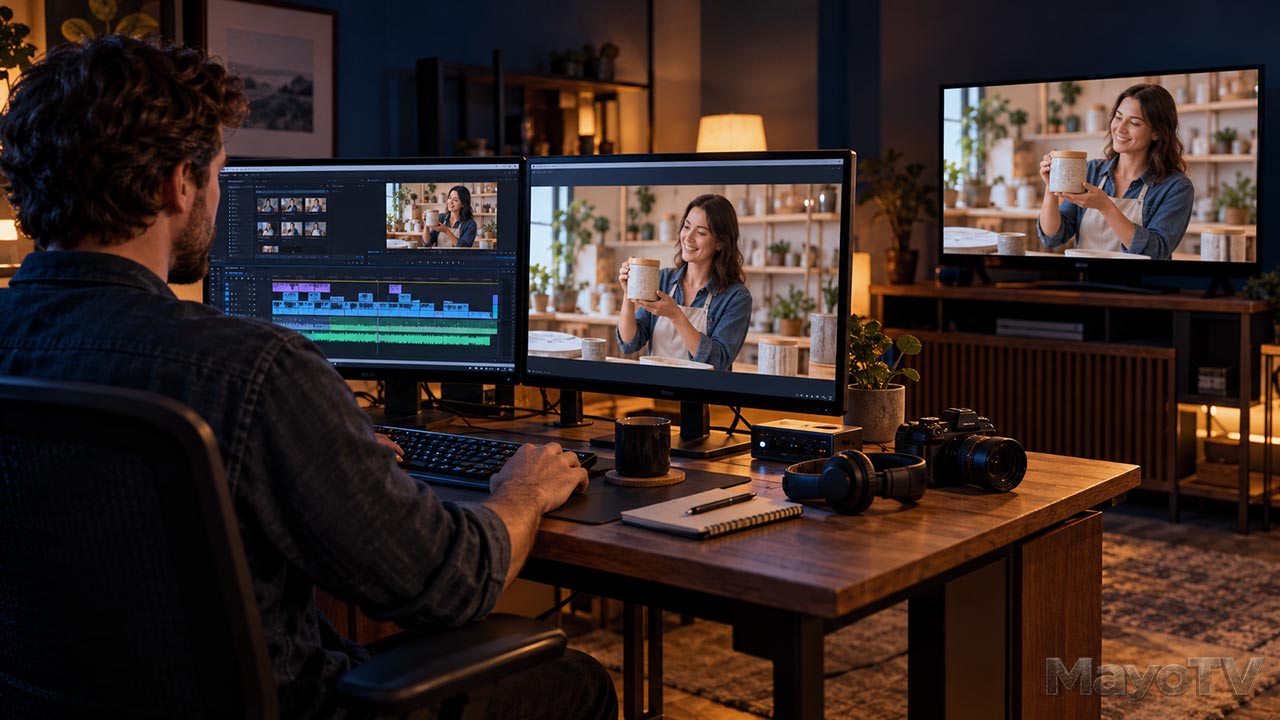
Several platforms offer automated creative generation or adaptation tools. That reduces some technical work, but a producer can still improve the substance: a focused script, convincing original footage, a useful product demonstration, clear dialogue, and editing that makes the offer understandable. [3, 5, 6]
Design graphics and captions for television viewing distance. Keep the call to action clear, allow time to understand it, and make the destination memorable. Check platform specifications before final export. Understanding the tools, formats, and workflows behind delivery is part of Media Technology: The Tools Behind Independent Content.
Creative variations give a campaign something meaningful to test. Change the opening, demonstration, offer presentation, or call to action with a specific hypothesis. For a small test, avoid splitting the budget across so many versions that each receives little exposure.
Campaign management adds responsibilities beyond editing. Someone must verify tracking, approve spending, monitor delivery, and explain results. Price and document that work separately when you provide it.
Start With One Business, One Offer, and a Defined Test
Consider a hypothetical Wilmington-area home-services business promoting a seasonal maintenance appointment. The audience is households within its service area, using whichever relevant targeting the selected platform actually supports.
The producer creates one 30-second commercial and one alternate opening. Both point to a dedicated landing page explaining the service, price or quotation process, and booking steps.
The business authorizes a $1,000 media ceiling for an initial test. That is an illustrative budget, not a forecast of adequate statistical power. Production and management charges are separate.
Before launch, test the form and conversion tracking. Record the attribution settings and define success using qualified inquiries, booked appointments, completed jobs, and cost per acquired customer. Review frequency and delivery, then compare platform claims with the business’s actual records.
The production agreement should specify scripts, runtimes, versions, revisions, usage rights, delivery formats, approvals, management duties, and reporting dates. Set spending authority explicitly. Defining what you deliver and how you charge for it is part of Creator Business: Turning Content into a Sustainable Business.
Promise the agreed work and an honest evaluation. Sales depend on the offer, targeting, competition, website, and follow-up as well as the commercial. The useful first step is a campaign that teaches the business something it can act on.
Frequently Asked Questions
What is Connected TV advertising?
Connected TV (CTV) advertising places commercials within streaming content watched on internet-connected televisions, including smart TVs and televisions connected through streaming devices. Buying these placements is separate from distributing your own show or operating a streaming channel.
How much does Connected TV advertising cost?
Costs vary by platform, audience, inventory, and campaign settings. Many platforms use CPM pricing, meaning cost per thousand impressions. For example, a $500 media budget at a $20 CPM would purchase approximately 25,000 impressions, assuming no additional deductions. Production and campaign management may cost extra, and impressions do not guarantee sales.
How can independent media producers offer CTV services?
Independent producers can write scripts, shoot original footage, record dialogue, edit commercials, and create versions for testing. They may also offer media buying and campaign management if they have the necessary skills. Production deliverables, advertising budgets, management responsibilities, and reporting should be clearly agreed upon with the client.
Sources
- Roku: CTV terminology and buying overview.
- MNTN: Platform features, pricing model, and service information.
- MNTN: Current platform, inventory access, and QuickFrame AI.
- Vibe: Streaming advertising offer and pricing help; Walmart: completed acquisition.
- tvScientific: Buying options; Pinterest: current offering and acquisition closing disclosure.
- Roku: Ads Manager setup and measurement and CPM pricing and creative tools.
- Amazon Ads: Streaming TV inventory, eligibility, and buying packages.
- Disney: Campaign Manager terms and minimum budget and Hulu/Disney+ selection.
- StackAdapt: Plans, minimums, and recommendations and CTV capabilities.
- MNTN Help Center: Attribution and Last Touch Verified Visits.
- MNTN Help Center: Exported data and cross-channel deduplication limitation.
















Leave A Comment